
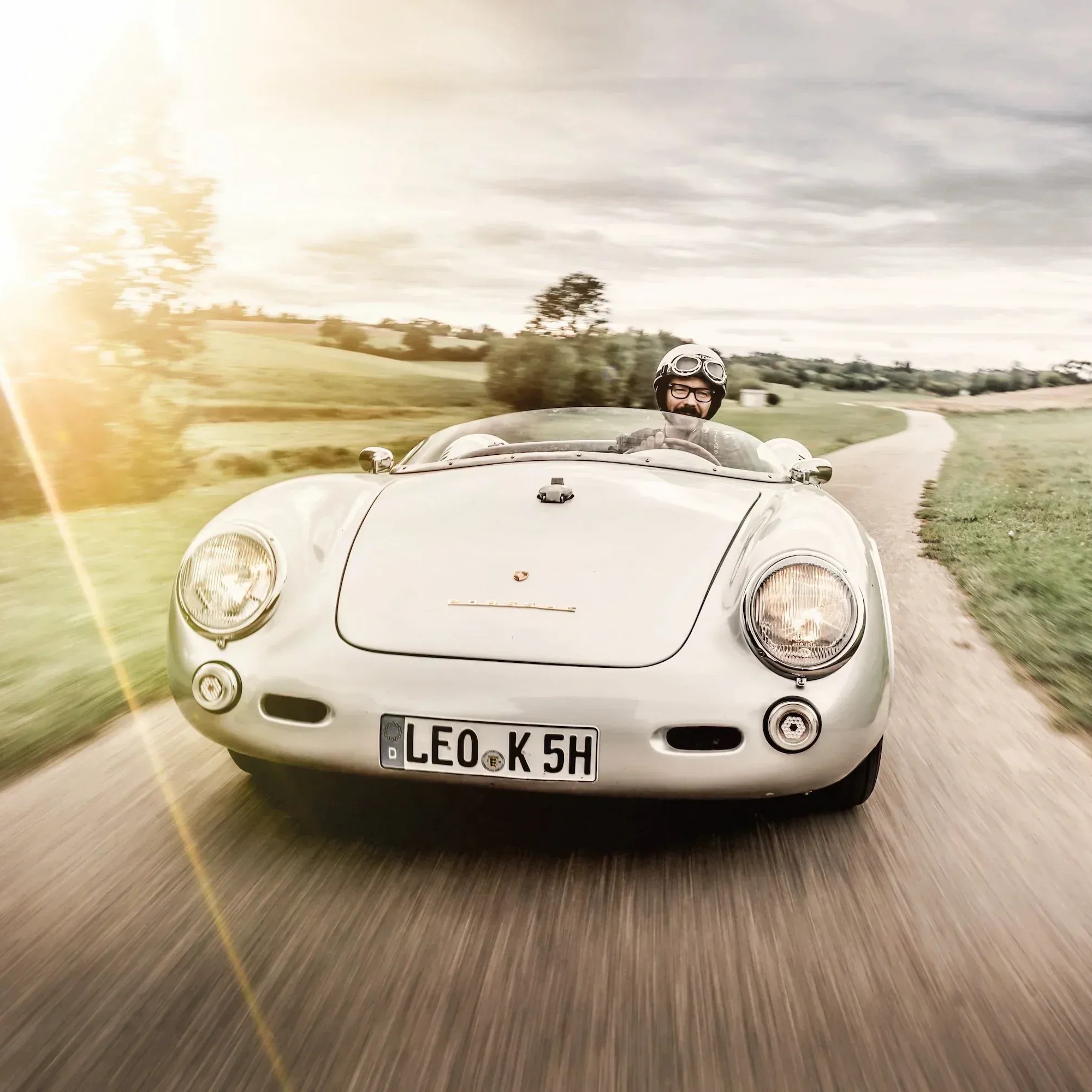
The Porsche 550 Spyder stands as one of the most iconic sports racing cars in automotive history. Introduced in the early 1950s, it quickly gained fame for its lightweight design, superior handling, and remarkable performance on both tracks and open roads. Moreover, its sleek, open-top body captured the imagination of drivers and enthusiasts alike. As a result, the Porsche 550 Spyder became more than just a race car—it evolved into a cultural symbol.
In addition to its engineering excellence, the Porsche 550 Spyder played a pivotal role in establishing Porsche’s reputation in international motorsports. Not only did it win numerous races, but it also laid the foundation for future high-performance models. Therefore, understanding its legacy means exploring not just its technical details, but also its impact on automotive culture and racing history.
Contents
- 1 Engineering Excellence Behind the Porsche 550 Spyder
- 2 Dominance in Motorsport Competitions
- 3 Cultural Impact and Hollywood Fame
- 4 Evolution of Performance Features
- 5 Rarity and Collector Value Today
- 6 Driving Experience: What Made It Special
- 7 Influence on Modern Porsche Models
- 8 Frequently Asked Questions
- 9 Final Thoughts on the Enduring Legacy of the Porsche 550 Spyder
 Engineering Excellence Behind the Porsche 550 Spyder
Lightweight Design and Aerodynamic Efficiency
Engineers at Porsche focused heavily on reducing weight while maintaining structural integrity. They used a tubular space frame chassis, which provided strength without adding unnecessary mass. Consequently, the overall vehicle weight stayed impressively low. In fact, this focus on lightness gave the Porsche 550 Spyder a significant advantage over heavier competitors.
Additionally, the body was sculpted with aerodynamics in mind. Its low-slung profile and smooth curves helped cut through the air efficiently. As a result, top speed and stability improved dramatically. Furthermore, every panel served a functional purpose—nothing was purely decorative. Thus, form followed function in true German engineering fashion. Drivers immediately noticed the responsiveness during cornering and acceleration. Meanwhile, engineers continued refining suspension geometry for better road contact. Ultimately, these innovations made the Porsche 550 Spyder a benchmark in sports car development.
Dominance in Motorsport Competitions
Victories That Cemented Its Legacy
From the moment it debuted, the Porsche 550 Spyder began racking up victories across Europe and beyond. It competed in grueling events like the Carrera Panamericana and the Targa Florio, where reliability and driver skill were pushed to the limit. Because of its balanced handling, it excelled on twisty mountain roads. Moreover, consistent finishes boosted Porsche’s credibility among elite manufacturers.
Then came Le Mans, where even partial class wins signaled growing competitiveness. Although outright victory eluded the model initially, podium finishes proved its endurance. In addition, privateer teams adopted the car widely due to its ease of maintenance and tuning flexibility. As a direct result, more entries meant greater exposure. Also, factory-backed efforts increased over time, showing Porsche’s commitment to racing success. Eventually, the combination of proven performance and accessible technology made the Porsche 550 Spyder a favorite among amateur and professional racers alike.
 Cultural Impact and Hollywood Fame
James Dean and the Tragic Mythology
Few cars carry the same level of mythological status as the Porsche 550 Spyder, especially due to its association with actor James Dean. He purchased one in 1955, naming it “Little Bastard,” and unfortunately died in a crash while driving it. This tragic event instantly elevated the car’s notoriety far beyond the racing world. Consequently, stories about cursed vehicles and ill fate began circulating.
Nevertheless, the connection between Dean and the Porsche 550 Spyder introduced the model to mainstream audiences. Magazines covered the story extensively, often blending fact with sensationalism. Over time, this narrative overshadowed the car’s actual achievements in engineering and competition. However, interest in original models surged, making surviving examples extremely valuable. Today, collectors seek out unrestored units for their historical significance. Even so, Porsche has never officially endorsed the “curse” legend. Still, the blend of celebrity, tragedy, and mechanical brilliance ensures lasting public fascination.
Evolution of Performance Features
Innovations That Shaped Future Porsches
One of the defining traits of the Porsche 550 Spyder was its mid-engine layout—a radical choice at the time. Placing the engine behind the driver improved weight distribution significantly. Therefore, handling became sharper and more predictable. In contrast, most rivals still used front-engine configurations, which limited agility. As a result, the Porsche 550 Spyder handled corners with precision unmatched by contemporaries.
Furthermore, the flat-four engine delivered reliable power without excessive complexity. Engineers tuned it carefully to maximize efficiency and responsiveness. Then, sequential drum brakes offered strong stopping power, though modern standards would find them modest. Nonetheless, for its era, the braking system worked well under race conditions. Additionally, gear shifting was precise thanks to a close-ratio manual transmission. Later models even experimented with five-speed units. These advancements didn’t just benefit the 550 Spyder—they influenced future generations of Porsche sports cars. Hence, many features pioneered here reappeared in later 718 and 911 series models.
 Rarity and Collector Value Today
Why Original Models Command High Prices
Today, owning an authentic Porsche 550 Spyder is a dream for serious collectors. Only around 90 were ever built, making it exceptionally rare. Due to this scarcity, any surviving example attracts intense interest at auctions. In fact, recent sales have seen prices exceed several million dollars. Therefore, demand continues to outpace availability.
Moreover, provenance plays a major role in valuation. Cars with documented race histories or famous former owners fetch even higher premiums. Restorations are common, but purists prefer original, unmodified units. On the other hand, some replicas exist, often built to mimic the look and feel of the real thing. However, they lack the authenticity that drives market value. As time passes, preservation becomes increasingly important. Museums and private collectors invest heavily in climate-controlled storage and expert maintenance. All these factors contribute to the enduring prestige of the Porsche 550 Spyder in today’s classic car market.
Driving Experience: What Made It Special
Precision Handling and Driver Engagement
Driving the Porsche 550 Spyder offered a raw, unfiltered experience unlike anything else of its time. There were no power steering systems or electronic aids—just mechanical feedback flowing directly from road to hands. As a result, drivers felt deeply connected to the machine. Every bump, turn, and shift communicated clearly through the chassis.
Additionally, the seating position placed the driver low and centered, enhancing balance perception. Because visibility was limited, especially to the rear, concentration remained high at all times. Nevertheless, the responsive steering made navigating tight circuits manageable. Meanwhile, throttle response was immediate, allowing fine control during acceleration. Even minor inputs produced noticeable changes in behavior. Thus, mastery required skill and practice. Many who drove it described the sensation as being “one with the car.” This level of engagement remains a hallmark of great sports cars—and the Porsche 550 Spyder exemplified it perfectly.
 Influence on Modern Porsche Models
Design and Philosophy Passed Down Through Generations
Modern Porsches owe much to the pioneering spirit of the Porsche 550 Spyder. Its emphasis on lightweight construction, balanced dynamics, and driver-focused design lives on in current models. For instance, the Cayman and Boxster share the mid-engine philosophy first perfected in the 550. Likewise, track-oriented variants like the GT4 reflect the same pursuit of pure performance.
Also, styling cues echo the original’s simplicity and elegance. Clean lines, round headlights, and minimal ornamentation remain central to Porsche’s aesthetic language. Engineers continue prioritizing weight reduction using advanced materials like aluminum and carbon fiber. Moreover, racing programs such as those in WEC trace their roots back to the 550’s competition successes. As a result, lessons learned decades ago still inform development decisions today. Porsche frequently references the 550 Spyder in marketing campaigns to highlight heritage. Clearly, its influence extends far beyond nostalgia—it shapes the brand’s identity.
Frequently Asked Questions
What makes the Porsche 550 Spyder so valuable?
The Porsche 550 Spyder holds immense value due to its rarity, racing pedigree, and cultural significance. With fewer than 100 units produced, each surviving example is highly sought after. Additionally, its success in motorsports adds historical importance. Collectors also prize its link to figures like James Dean, despite the tragic circumstances. Restoration quality and originality further affect pricing.
Was the Porsche 550 Spyder street-legal?
Yes, the Porsche 550 Spyder could be driven on public roads, although it was primarily designed for racing. Basic lighting, mirrors, and license plate mounts met minimal legal requirements. However, comfort features were nearly nonexistent. Therefore, long-distance travel was impractical. Most owners used it for track days or short scenic drives.
How fast was the Porsche 550 Spyder?
Top speed ranged between 135 and 150 mph depending on configuration. Acceleration from 0 to 60 mph took roughly 7 seconds—an impressive figure for the 1950s. Power output varied between 100 and 135 horsepower based on tuning. Higher states of tune appeared in race-spec versions. Aerodynamics and low weight contributed significantly to performance.
Are there modern recreations available?
Several companies build accurate reproductions using original blueprints. These replicas aim to capture the look and driving feel of the genuine article. Some use modern mechanical components for reliability. Others stay faithful to period-correct specifications. While not as valuable as originals, they allow enthusiasts to experience the thrill affordably.
 Final Thoughts on the Enduring Legacy of the Porsche 550 Spyder
A True Pioneer in Automotive History
The Porsche 550 Spyder remains a cornerstone of Porsche’s legacy. From its debut in the 1950s to its lasting influence today, it represents innovation, courage, and passion. Not only did it achieve remarkable success on the track, but it also captured hearts worldwide. Its minimalist design and mechanical purity set standards that still resonate.
Even now, new generations discover its story through films, books, and museum displays. Enthusiasts admire its role in shaping Porsche’s identity. Meanwhile, collectors treat surviving models as priceless artifacts. Whether viewed as a technological marvel or a cultural icon, the Porsche 550 Spyder continues to inspire. Therefore, its place in automotive history is secure—for it was not merely a car, but a revolution on wheels.